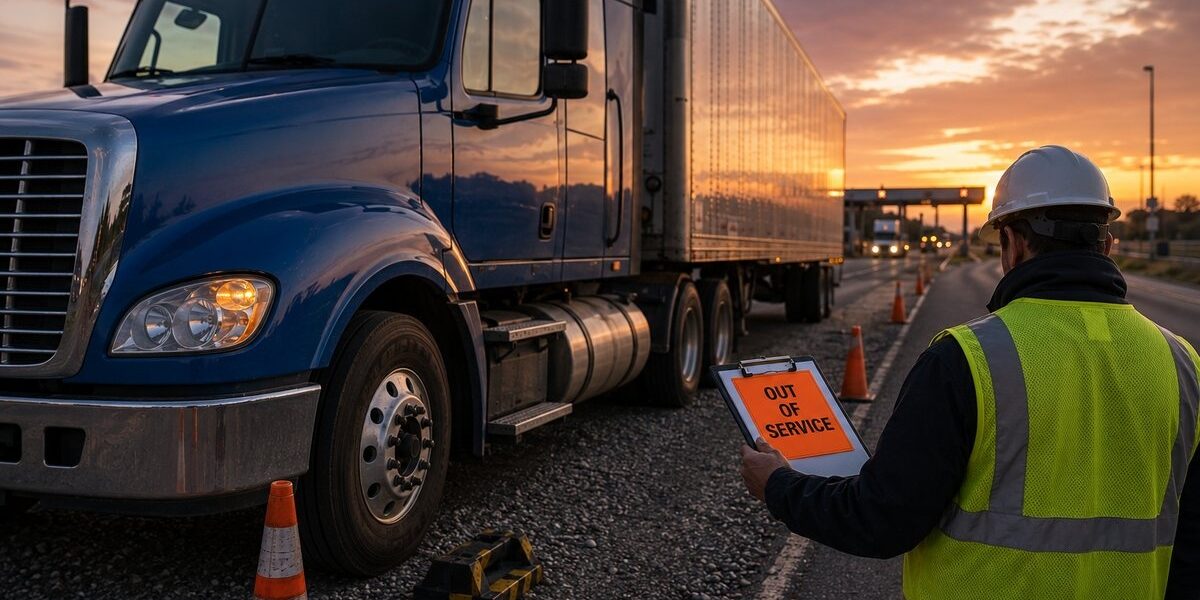
A single roadside inspection can freeze your entire operation. A DOT officer places an orange “OUT OF SERVICE” sticker on your rig, and just like that — you and your truck cannot move a mile until the defect is fixed. For an owner-operator, that’s lost revenue, missed deliveries, and a CSA score hit that follows you for years.
At Ensure Inc. in Barrington, Illinois, we help commercial trucking clients understand what an out-of-service (OOS) violation actually means, how to resolve it fast, and how it changes what your insurance carrier charges you at the next renewal. Here is the plain-English guide.
What Is an Out-of-Service Violation?
An out-of-service violation is issued when a DOT inspector finds a defect on your truck, trailer, or driver record that meets criteria in the Federal Motor Carrier Safety Regulations (FMCSR) or the North American Standard Out-of-Service Criteria. The moment that sticker is placed, you (the driver) or your vehicle cannot legally operate on the road until the violation is corrected.
OOS violations come in three flavors:
- Vehicle OOS. A mechanical defect — brake problem, tire, lighting, coupling device — that makes the truck unsafe to drive. The truck stays put until repaired and cleared.
- Driver OOS. The driver personally cannot operate for reasons such as hours-of-service violations, invalid CDL, or failing a drug/alcohol screen. The truck can move if a qualified driver takes over.
- Company/Operations OOS. Rare but severe — the entire motor carrier operation is shut down by FMCSA (usually for a pattern of safety violations or an imminent hazard finding).
Top 5 Reasons Trucks Get Placed Out-of-Service
Every year the Commercial Vehicle Safety Alliance publishes inspection data. The same defects show up over and over. If you want to avoid an OOS event, know the top five triggers cold:
- Brake system defects. Consistently the #1 cause of vehicle OOS violations. Out-of-adjustment slack adjusters, air leaks, mismatched brake chambers, worn linings. Pre-trip your brakes like your revenue depends on it — because it does.
- Tires and wheels. Flat, cut, or below-tread-depth tires. Missing lug nuts. Damaged rims. These are visible from ten feet away, and inspectors will find them.
- Lighting and marking. Non-functioning headlights, marker lights, brake lights, turn signals. Reflective conspicuity tape missing or damaged. Cheap to fix — expensive when it stops you cold.
- Hours-of-service violations. The most common driver OOS. Falsified logs, exceeded driving windows, missed rest periods. ELDs made this harder to hide but not harder to accidentally cross into.
- Load securement. Straps, chains, tarps, blocking, and bracing. If cargo can shift, an inspector can and will place you out-of-service.
How to Handle an Out-of-Service Violation — Step by Step
When you or your truck is placed OOS, the clock starts on lost revenue and compounding penalties. Here is the workflow we walk clients through:
Document the Inspection Report
Get the full Driver/Vehicle Inspection Report (DVIR) with every violation code listed. Photograph the OOS sticker location. You will need every detail for the repair, the challenge (if any), and the insurance carrier notification.
Repair the Defect at an Authorized Facility
A qualified mechanic or driver (depending on defect) resolves the specific violation. Do not attempt roadside patches on brake or steering defects — those need a certified shop and documented parts.
Get Written Verification of the Fix
The repair shop issues a signed statement confirming the defect is corrected. Retain the parts receipt, the labor log, and the mechanic’s certification. This is your evidence in every downstream conversation — DOT, insurance, CSA challenge.
Notify Your Insurance Agent Within 48 Hours
Do not hide the violation. Your carrier will find it at renewal via the CSA data. Reporting early with a full repair record often keeps the premium impact modest; hiding it and letting them discover it costs multiples more.
Challenge the Violation via DataQs If Justified
If the inspector misapplied the criteria — wrong measurement, mistaken defect classification, incorrect driver assignment — file a DataQs Request for Data Review with FMCSA. Attach the repair verification and any evidence. A successful challenge removes the violation from your CSA score.
How OOS Violations Affect Your Insurance Rates
Every commercial trucking insurance carrier pulls your CSA (Compliance, Safety, Accountability) score at renewal. Your CSA measurement weighs recent violations more heavily than older ones, and OOS violations count for significantly more than a standard warning. In practical terms:
- One OOS in the last 24 months can add 8–25% to your commercial auto liability premium at renewal, depending on carrier and defect type.
- Two or more OOS events in that window can shift you out of preferred-carrier eligibility entirely, forcing a non-standard market with 40–80% premium increases.
- A driver OOS for drugs, alcohol, or falsified logs may require immediate program placement (Substance Abuse Professional / SAP) and can trigger a policy non-renewal.
This is why step 4 in the workflow above matters so much. A clean, documented resolution — reported early — is your best insurance-side outcome.
Common Out-of-Service Mistakes to Avoid
- Rolling anyway. Some drivers try to move the truck a short distance to a repair shop. Federal law prohibits operating an OOS vehicle even in that scenario without a proper hauler. Getting caught adds fines and driver-record damage.
- Ignoring the DataQs window. You have limited time to challenge the violation. A valid challenge submitted after the window is functionally worthless.
- Skipping the insurance notification. Late disclosure at renewal is treated as a material misrepresentation. Consequences range from steep premium increases to policy cancellation.
- Cheap parts, no receipts. Repairs done off-book with unmarked parts and no labor documentation cannot be verified. If DOT re-inspects and finds the defect back, the entire chain of events multiplies against you.
- Not tracking the driver’s record separately. Driver OOS violations follow the driver, not the truck. Terminating the driver without proper documentation transfers CSA points differently than expected — talk to a compliance advisor before you act.
A Note on Language
Federal safety paperwork is dense and time-critical, and every hour costs you money. Our team at Ensure Inc. handles OOS violation triage and insurance-side reporting in English, Polish, Ukrainian, and Russian — the four languages most commonly spoken across our Chicagoland trucking clientele. If you are more comfortable working through a serious compliance issue in your first language, we have you covered.
Frequently Asked Questions
How long does an out-of-service violation stay on my CSA record?
CSA measurements use a 24-month rolling window, with more recent violations weighted more heavily than older ones. An OOS event affects your score most in the first 6 months, then diminishes gradually. It fully drops off after 24 months if not renewed by a similar violation.
Can I move my truck to a repair shop after an OOS sticker is placed?
Not without a proper hauler or tow. Federal law prohibits operating a vehicle placed out-of-service until the specific defect is corrected. Use a certified tow service or bring the mechanic to the truck.
What is DataQs and when should I use it?
DataQs is FMCSA’s online system for challenging inspection results. Use it when you have evidence the violation was misapplied — wrong measurement, wrong regulation cited, wrong driver assignment. Attach documentation. A successful challenge removes the violation from your CSA score.
Will one OOS violation get my policy canceled?
A single mechanical OOS rarely triggers cancellation, though it typically increases your renewal premium. However, driver OOS violations tied to drugs, alcohol, or falsified logs can trigger non-renewal or force placement in a non-standard market.
Does Ensure Inc. help with the DataQs challenge process?
We help you prepare the documentation package and identify whether a challenge is likely to succeed. We do not file the DataQs itself on your behalf (that stays with the motor carrier), but we ensure your insurance file reflects the corrective action so your renewal position is protected.