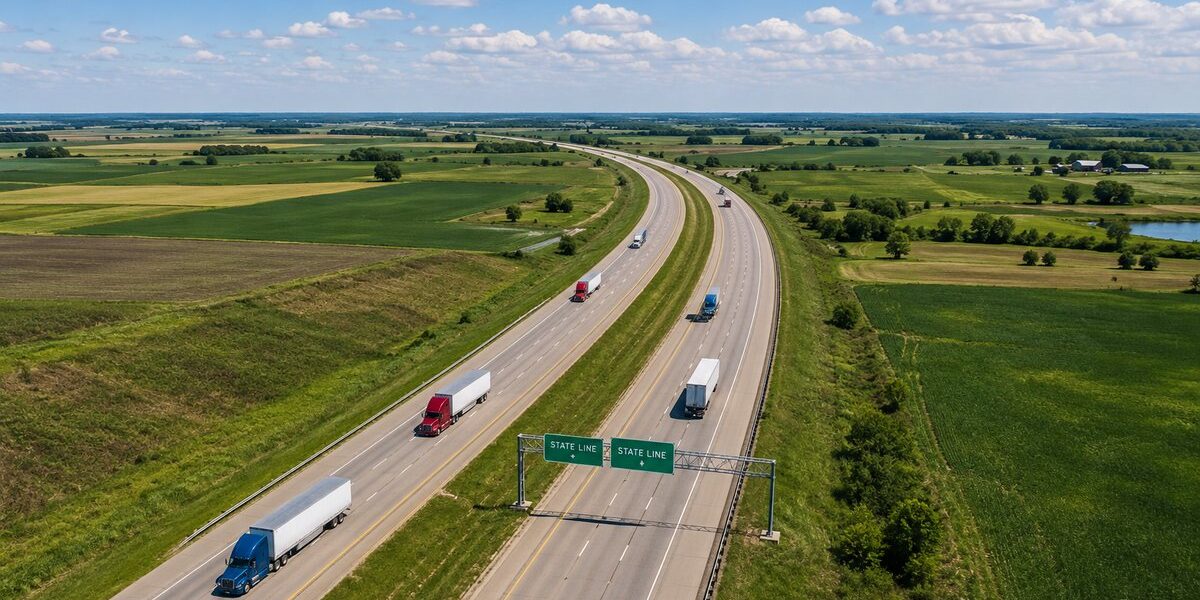
If you drive a truck across state lines, you cross legal borders that change the rules on how your injury bills get paid after a crash. In some states, your own insurance pays first (no-fault). In others, whoever caused the crash pays. Personal Injury Protection — PIP — is the coverage that navigates that boundary, and for commercial truck drivers it works a little differently than the personal-auto version.
At Ensure Inc. in Barrington, Illinois, we help owner-operators and small motor carriers understand where PIP applies to their operation, how it interacts with workers’ compensation and commercial auto medical coverage, and how to file a claim without leaving money on the table.
What Is PIP Insurance?
Personal Injury Protection is a no-fault insurance coverage that pays for medical bills, lost wages, and sometimes essential services (childcare, housekeeping) after a covered auto accident — without asking who was at fault. It exists to keep money flowing to injured people quickly, so they can get treated and back to work without waiting for a fault determination to grind through the legal system.
PIP is required in some states, optional in others, and unavailable in still others. Whether it applies to your commercial truck policy depends on the state where the vehicle is registered AND the state where the crash occurred.
PIP vs Workers’ Comp vs Commercial Auto Medical
Three different coverages can pay for injury bills after a commercial trucking crash. Understanding the interaction matters:
- PIP. Covers the driver’s medical bills up to the policy limit, regardless of fault. Applies in no-fault states. Typically requires the injured person to submit bills within a claim window. Often pays lost wages and some replacement services too.
- Workers’ Compensation. Covers a driver who is injured while working. This is separate from the auto policy entirely — it comes from the employer’s workers’ comp carrier. Bills and lost wages get paid without a fault dispute, but the driver typically gives up the right to sue the employer.
- Commercial Auto Medical Payments (MedPay). Optional coverage on the commercial auto policy that pays medical bills without regard to fault. Usually a lower limit than PIP. Common in at-fault states as a substitute for PIP.
Under most state coordination-of-benefits rules, workers’ comp pays first for on-duty crashes, then PIP or MedPay fills the gap, then the at-fault party’s liability insurance pays what remains. The order matters — a missed step means bills go unpaid or the driver ends up with medical debt in collections.
No-Fault States Where PIP Applies
Twelve states plus Puerto Rico currently operate no-fault regimes with mandatory or optional PIP:
- Florida — mandatory PIP minimum $10,000
- Hawaii — mandatory PIP minimum $10,000
- Kansas — mandatory PIP minimum $4,500 medical + wage and survivor benefits
- Kentucky — mandatory PIP minimum $10,000 (opt-out available)
- Massachusetts — mandatory PIP minimum $8,000
- Michigan — PIP with historically the highest medical limits in the nation (reforms changed the structure in recent years)
- Minnesota — mandatory PIP minimum $40,000 total
- New Jersey — mandatory PIP minimum $15,000, with unlimited options
- New York — mandatory PIP minimum $50,000
- North Dakota — mandatory PIP minimum $30,000
- Pennsylvania — mandatory PIP minimum $5,000 (choice of tort options)
- Utah — mandatory PIP minimum $3,000
If a crash happens in a no-fault state, PIP typically applies even if the vehicle is registered in an at-fault state. Rules on this vary by state and policy language — ask your agent to confirm your specific coverage before assuming.
How to File a PIP Claim — Step by Step
Timing is everything with PIP. Miss the notification window and the claim is denied. Here is the workflow we walk clients through:
Notify Your Insurance Carrier Within 24–72 Hours
Every state has a specific PIP claim notification window — usually 24, 48, or 72 hours after the crash. Miss it and the claim can be denied outright. Call your commercial insurance agent the same day, follow up in writing within 48 hours. Include the DOT number, crash location, involved parties, and injury summary.
Coordinate PIP with Workers’ Comp
If the driver was on duty, workers’ comp typically pays first. PIP fills the gap. Your commercial auto carrier and workers’ comp carrier need to talk. Get both adjusters on a single call within the first week so coordination happens at the front, not the back, of the claim.
Document Medical Treatment and Lost Wages
Every provider bill, every doctor’s note, every day of missed work — save it. PIP pays medical bills submitted with documentation, and lost wages substantiated by employer wage statements. Undocumented losses do not get paid.
Submit Claim Package to the Adjuster
Bundle medical bills, wage statements, crash report, and any physician disability notes into one package. Submit via the adjuster’s preferred method (portal upload, email, or physical mail). Retain copies. Follow up if you have not received acknowledgment within 5 business days.
Receive Payment and Close the Claim
PIP payments typically arrive within 30–90 days after submission if documentation is complete. If the adjuster denies or reduces a claim, request written reason and escalate through your agent. If the injury requires ongoing treatment, keep the file open and submit follow-up bills as they arrive.
Common PIP Pitfalls for Commercial Drivers
- Assuming PIP applies everywhere. Only 12 states have no-fault PIP regimes. If the crash happens in an at-fault state, PIP may not apply at all — you fall back to commercial auto MedPay (if you carry it) and liability recovery from the at-fault party.
- Missing the notification window. 24–72 hour deadlines vary by state and policy. Same-day notification is the safe default. Late notification is the fastest way to get a claim denied.
- Not coordinating with workers’ comp. Workers’ comp and PIP often overlap for on-duty drivers. Failing to coordinate leads to double-billing (illegal), payment gaps (bills unpaid), or denied claims.
- Ignoring the tort threshold. Some no-fault states (like PA and NJ) have a tort threshold — if injuries exceed a specified severity, you can sue the at-fault party in addition to collecting PIP. Below the threshold, PIP is your only recovery.
- Under-insuring PIP limits. The minimum $3,000–$10,000 PIP limits in many states cover a small fraction of serious commercial crash injuries. Consider a policy with higher optional PIP limits, or MedPay, or both.
Insurance Impact of a PIP Claim
- A single first-party PIP claim usually has minor renewal impact — no-fault means no at-fault surcharge.
- Multiple PIP claims within 3 years can push you toward a higher-risk classification even without a fault determination, because carriers measure frequency independently.
- PIP claim with associated CSA impact (an accompanying HOS or vehicle violation on the crash report) affects the CSA score and can trigger the normal at-fault renewal surcharge stack.
A Note on Language
Coordination of PIP, workers’ comp, and liability recovery after a serious crash is one of the most complex conversations an owner-operator has with an insurance adjuster. Our team at Ensure Inc. handles PIP claim coordination in English, Polish, Ukrainian, and Russian. If you are more comfortable navigating a medical-recovery process in your first language, we have you covered.
Frequently Asked Questions
Does my truck registered in Illinois get PIP coverage if I crash in Florida?
Usually yes. Most policies extend PIP coverage to no-fault states where you operate, even if the truck is registered in an at-fault state. However, the coverage amount, benefits, and rules default to the no-fault state where the crash happened. Confirm with your specific policy language.
If workers’ comp already pays my medical bills, why do I need PIP?
Workers’ comp only covers on-duty injuries. PIP covers everyone in the vehicle, including passengers and family members if applicable. PIP also often pays lost wages faster than workers’ comp, and covers non-medical expenses (childcare, housekeeping) that workers’ comp does not.
Can I still sue the at-fault party in a no-fault state?
Only if your injuries exceed the state’s tort threshold — typically a defined severity, permanent impairment, or dollar amount. Below the threshold, PIP is your exclusive remedy. Above the threshold, you can pursue liability recovery in addition to PIP.
How high should my PIP limit be?
State minimums are almost always too low for a serious commercial crash. We recommend at least $25,000–$50,000 PIP limit for owner-operators, higher for multi-vehicle fleets. The extra premium is modest relative to the coverage gap.
Does Ensure Inc. help with PIP claim coordination?
Yes. We coordinate between your commercial auto carrier, workers’ comp carrier, and any third-party liability adjusters. We help clients meet notification deadlines, assemble documentation packages, and escalate when adjusters deny or delay. We do not represent you in litigation — that is your attorney’s job — but we make sure the insurance side of your recovery moves as fast as possible.