
- Facts at a Glance
- What Is Trailer Interchange Insurance?
- Which Policy Pays for What?
- What It Covers — and What It Doesn’t
- Trailer Interchange vs. Non-Owned Trailer Coverage
- Trailer Interchange and the UIIA
- If Equipment Is Damaged: What Happens Next
- A Real-World Example
- What Affects Limits and Premium
- 6 Questions to Ask Before You Buy
- How We Verified This Article
- 14 Frequently Asked Questions
- Sources & References
Facts at a glance
What Is Trailer Interchange Insurance?
When you pick up a container on a chassis at a rail ramp, or pull a trailer that belongs to someone else, the equipment is in your care, custody, and control — but it isn’t yours. As FreightWaves Checkpoint puts it, once you sign for a trailer and take it, you are responsible for physical damage until you return it.
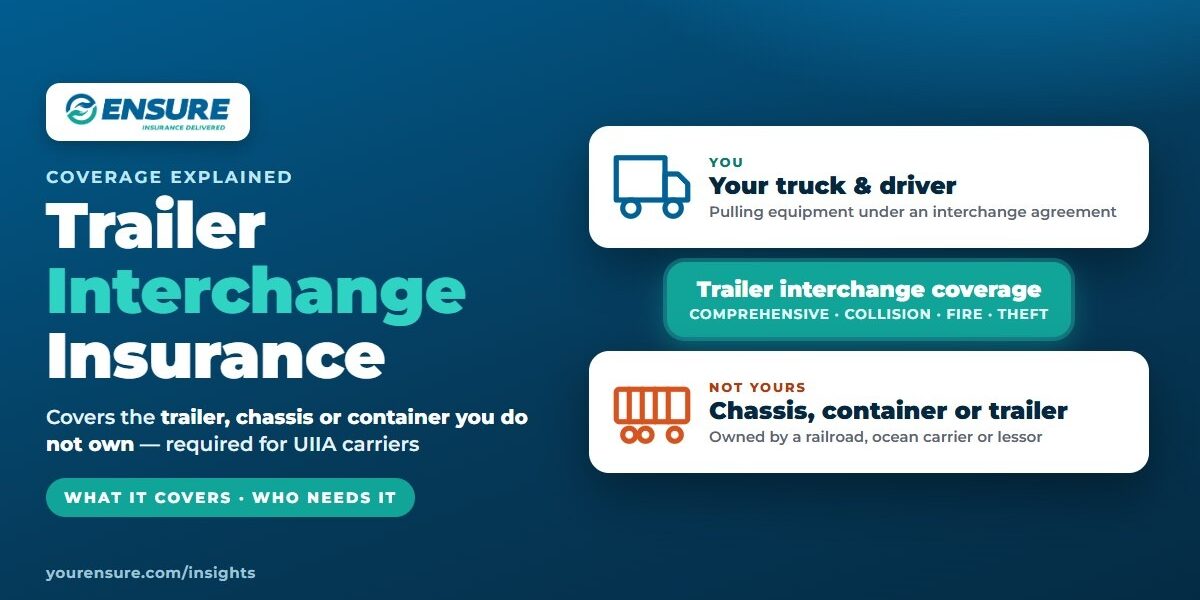
Trailer interchange insurance covers that exposure. For UIIA participants, IANA describes it as insurance covering physical damage to non-owned equipment — containers, chassis, and/or trailers — in the carrier’s care. It is the coverage that lets you sign an interchange agreement, including the UIIA, and stand behind it.
Which Policy Pays for What?
Commercial trucking insurance is a stack of different coverages, and each one answers a different question. Here is the simplified map for an intermodal carrier:
What It Covers — and What It Doesn’t
IANA’s UIIA requirement says trailer interchange coverage must include comprehensive, collision, fire, and theft coverage for the non-owned equipment. FreightWaves Checkpoint (March 16, 2026) also lists vandalism and weather-related damage among typical covered losses.
What policies typically exclude, per the same article: the cargo inside; bodily injury or third-party property damage; wear and tear or mechanical breakdown; refrigeration unit failures; fines, penalties, or contractual damages; and intentional or dishonest acts. Exclusions differ by insurer, so read the form. (FreightWaves Checkpoint — What Is Trailer Interchange Insurance? (Mar. 16, 2026))
Trailer Interchange vs. Non-Owned Trailer Coverage
The two names get mixed up constantly, and the difference matters. Trailer interchange coverage applies when you haul trailers under a formal written interchange agreement. Non-owned trailer coverage generally protects trailers you use without one — borrowed, rented, or customer-owned trailers used occasionally. (Wexford Insurance — Trailer Interchange vs. Non-Owned Trailer Coverage)
If you take part in the UIIA, confirm with your agent which form is on your policy — the wrong form can leave you with a certificate that looks fine and a claim that isn’t.
Trailer Interchange and the UIIA
For UIIA participants, trailer interchange is not optional. IANA’s requirements call for a limit per trailer and a deductible on the insurance submission and state that limits and deductibles vary by equipment provider (see each provider’s rules). Equipment providers must be named as additional insured on the appropriate policies, and the UIIA expects 30 days’ notice of cancellation (10 days for non-payment). (IANA — UIIA Insurance Requirements)
The insurer matters too. Progressive’s UIIA page lists trailer interchange coverage among the policy requirements (alongside $1M auto liability and $1M hired auto), and IANA requires extra confirmation from Progressive, Knight’s Specialty, Trisura, and Accredited Specialty. See our UIIA insurance requirements guide for the full checklist and the 38-state Progressive update.
If Equipment Is Damaged: What Happens Next
This is where the coverage earns its keep — and where the UIIA’s own rules protect you, if you know them. From IANA’s FAQ:
- Who is responsible for what. The UIIA’s Exhibit B lists the owner’s normal wear-and-tear items; Exhibit C lists the items the motor carrier is responsible for during the interchange. Exhibit A lists what the motor carrier must check visually or audibly before using the equipment.
- What the provider must show you. For repair charges, the equipment provider must supply a copy of the actual repair invoice and factual documentation supporting its determination that you are responsible — for example, in-gate receipts.
- How long the provider has to bill. Not later than 165 calendar days (standard gate systems); not later than 120 calendar days following interchange (AGS gates); and no later than 90 calendar days from the repair date for repairs made during the interchange.
Practical tip (ours, not IANA’s): inspect and photograph equipment at pickup and return, and keep those records until the billing windows above have passed. IANA states it cannot provide legal interpretations of the agreement, so bring disputed charges to your agent early. (IANA — UIIA FAQ)
A Real-World Example
What Affects Limits and Premium
There is no honest one-size-fits-all number, because trailer interchange is priced on your actual exposure. The factors insurers typically weigh:
- Equipment values — a chassis plus a loaded container can be worth far more than a single dry van;
- Number of units and how often you interchange;
- Equipment providers you use and the limits and deductibles they require;
- The deductible you choose;
- Terminals, yards, and states where you operate;
- Loss history and driver experience;
- The insurer — IANA notes some equipment providers do not accept risk retention group policies.
The fastest way to a real number is a quote built on your operation.
6 Questions to Ask Before You Buy
Which EPs, which limits?
List every equipment provider you interchange with and what limit per trailer and deductible each requires.
Does the limit fit the equipment?
Compare the per-trailer limit to what a chassis plus container is worth — not just a single trailer.
Can you afford the deductible?
Ask what one claim would cost you out of pocket at the deductible on the quote.
Which perils are included?
IANA requires comprehensive, collision, fire, and theft. Confirm all four — and read the exclusions.
Are EPs additional insured?
Confirm additional-insured wording and 30 / 10-day cancellation notice on the policies submitted to UIIA.
Will the insurer confirm to IANA in time?
For some insurers, IANA requires confirmation within 24 hours of the certificate being submitted. Ask who does it and when.
How Ensure Inc. Can Help
At Your Ensure Inc in Barrington, Illinois, our Transportation Risk Specialists focus on commercial trucking accounts. Send us your equipment providers, limits, and expiration date and we will check the auto policy form and hold-harmless endorsement, cargo, trailer interchange, additional-insured wording, and renewal timing against the UIIA requirements — and explain what we find in English, Polish, Ukrainian, or Russian.
- Read IANA’s UIIA Insurance Requirements, the UIIA FAQ, and the Quick Reference for Insurance Agents (revised May 14, 2026).
- Read FreightWaves Checkpoint’s trailer interchange explainer (March 16, 2026), Wexford Insurance’s comparison with non-owned trailer coverage, and Progressive Commercial’s public UIIA page.
- Every requirement and time window here is copied from IANA. Coverage descriptions marked “typically” come from the trade and insurer sources named and vary by policy.
- The example is illustrative; it is not a real claim.
- Equipment providers’ current limits and deductibles (they vary; see each provider’s rules).
- Insurance prices: none of the sources we rely on publish prices specific to UIIA intermodal carriers, so we do not quote any.
Spotted an error? Email request@yourensure.com and we will check it and log the fix in the Update Log below.
Your Ensure Inc was established in 2015 by Monika Lajewska as a one-woman operation and is now a team of insurance professionals with expertise in transportation accounts. Our team includes Transportation Risk Specialists — a designation offered by the Motor Carrier Insurance Education Foundation (MCIEF), a nonprofit that provides education to insurance professionals who serve the transportation industry.
Languages: English, Polish, Ukrainian, Russian (varying by team member) · Office: 101 Lions Dr Ste 110, Barrington, IL 60010 · Phone: 1-847-316-9933 · Meet the team →
A Note on Language
Insurance forms and endorsements are technical — even for native English speakers. Our team at Your Ensure Inc works with trucking clients in English, Polish, Ukrainian, and Russian, so requirements, endorsements, and deadlines get explained in the language you are most comfortable with — before you commit to a policy.
Frequently Asked Questions About Trailer Interchange Insurance
Answers to the most common questions about Trailer Interchange Insurance, drawn from what people search for and from IANA’s own FAQ. Tap a question to open its answer — one at a time. Each answer starts with the short version, then the detail, then the source. Last verified: September 29, 2026.
What is trailer interchange insurance?
Trailer interchange insurance is physical damage coverage for non-owned trailers, chassis, and containers while they are in a motor carrier’s care, custody, or control under a written interchange agreement. IANA describes it for UIIA participants as insurance covering physical damage to non-owned equipment (containers, chassis and/or trailers) in the insured’s care. It is separate from cargo insurance, which covers the freight inside.
Source: IANA — UIIA FAQ; FreightWaves Checkpoint — What Is Trailer Interchange Insurance? (Mar. 16, 2026).
What does trailer interchange insurance cover?
For UIIA participants, IANA requires trailer interchange coverage to include comprehensive, collision, fire, and theft. FreightWaves Checkpoint (Mar. 16, 2026) also lists vandalism and weather-related damage among typical covered losses. Wording differs by insurer, so read the form.
Source: IANA — UIIA Insurance Requirements; FreightWaves Checkpoint — What Is Trailer Interchange Insurance? (Mar. 16, 2026).
What does trailer interchange insurance NOT cover?
Trailer interchange policies typically exclude the cargo inside, bodily injury or third-party property damage, wear and tear or mechanical breakdown, refrigeration unit failures, fines or contractual penalties, and intentional damage. That list is FreightWaves Checkpoint’s description of typical policies. Your policy may differ, so ask your agent to show you the exclusions before you buy.
Source: FreightWaves Checkpoint — What Is Trailer Interchange Insurance? (Mar. 16, 2026).
Is trailer interchange insurance required for the UIIA?
Yes. IANA requires UIIA motor carriers to show trailer interchange coverage — a limit per trailer and a deductible — and states that limits and deductibles vary by equipment provider. Progressive’s UIIA page also lists trailer interchange coverage among the requirements for a Progressive UIIA policy.
Source: IANA — UIIA Insurance Requirements; IANA — Quick Reference for Insurance Agents (rev. May 14, 2026); Progressive Commercial — UIIA insurance.
What is a trailer interchange agreement?
A trailer interchange agreement is a written contract under which one party takes possession of another party’s trailer or equipment; for intermodal equipment, the standard agreement is the UIIA. Trailer interchange insurance responds to your exposure under such an agreement. FreightWaves Checkpoint notes that this coverage applies with a signed interchange agreement; without one, non-owned trailer coverage may give partial protection.
Source: FreightWaves Checkpoint — What Is Trailer Interchange Insurance? (Mar. 16, 2026); IANA — UIIA FAQ.
What is the difference between trailer interchange and non-owned trailer coverage?
Trailer interchange coverage applies when you haul trailers under a formal written interchange agreement, while non-owned trailer coverage generally protects trailers you use without one, such as rented, borrowed, or customer-owned trailers. Both address similar perils (collision, fire, theft, vandalism, weather). UIIA participants should confirm their policy carries the interchange form.
Source: Wexford Insurance — Trailer Interchange vs. Non-Owned Trailer Coverage; FreightWaves Checkpoint — What Is Trailer Interchange Insurance? (Mar. 16, 2026).
What is the difference between trailer interchange and cargo insurance?
Trailer interchange pays for physical damage to the borrowed equipment itself — the trailer, chassis, or container — while cargo insurance pays for the freight inside it. The UIIA requires both: cargo (Motor Truck Cargo / Cargo wording; in-transit coverage is not acceptable) and trailer interchange, each with limits that satisfy your equipment providers.
Source: IANA — UIIA Insurance Requirements; IANA — UIIA FAQ.
Does my auto liability policy cover the chassis or trailer I am pulling?
Typically not: auto liability is designed to pay for damage you cause to other people and their property, and commercial auto liability forms commonly exclude property in the insured’s care, custody, or control — the gap trailer interchange coverage is meant to fill. Wording varies by insurer, so ask your agent to show you that exclusion in your own policy and to confirm the trailer interchange coverage is on it.
Source: FreightWaves Checkpoint — What Is Trailer Interchange Insurance? (Mar. 16, 2026) (care, custody, and control responsibility under an interchange agreement).
How much trailer interchange coverage do I need?
It depends on your equipment providers: each sets its own trailer interchange limits and deductibles for UIIA participants. IANA points carriers to each provider’s rules (EP Rules, Form 5B), and UIIA participants can download EP addenda information from their account. As a sanity check, compare the per-trailer limit with what a chassis plus a loaded container would cost to repair or replace.
Source: IANA — UIIA Insurance Requirements; IANA — UIIA FAQ.
How much does trailer interchange insurance cost?
There is no single price: it depends on the equipment you pull, number of units, deductible, states and terminals, loss history, driver experience, and the insurer. Price ranges quoted in general-trucking articles are not specific to UIIA intermodal work, so we do not quote a price here. The reliable number is a quote based on your operation — call 1-847-316-9933 or email request@yourensure.com.
Who pays when equipment is damaged during an interchange?
The UIIA sets out which items are the owner’s normal wear and tear (Exhibit B) and which are the motor carrier’s responsibility during the interchange (Exhibit C), and equipment providers must back repair bills with documentation. For repair charges, IANA says the provider must supply a copy of the actual repair invoice and factual documentation supporting its determination that the motor carrier is responsible (for example, in-gate receipts). Exhibit A lists items the motor carrier must check before using the equipment. IANA notes it cannot provide legal interpretations of the agreement.
Source: IANA — UIIA FAQ.
How long can an equipment provider wait to bill me for repairs?
IANA’s FAQ gives three billing windows for repair charges: not later than 165 calendar days for standard gate systems, not later than 120 calendar days following interchange for AGS gates, and no later than 90 calendar days from the date of the repair for repairs made during the interchange. Check the UIIA’s M&R provisions for exactly how each period is measured, and keep your inspection records until the window has passed.
Source: IANA — UIIA FAQ.
Does trailer interchange coverage apply to containers and chassis, not just trailers?
Yes. IANA’s description of UIIA trailer interchange coverage refers to non-owned containers, chassis, and/or trailers. This is why intermodal carriers should size the limit to the combined value of a chassis and a container.
Source: IANA — UIIA FAQ.
Do I need trailer interchange insurance if I only pull my own trailer?
Generally no: trailer interchange coverage is for non-owned equipment in your custody under an interchange agreement, and equipment you own falls under your regular physical damage coverage. If you take part in the UIIA and pull equipment owned by ocean carriers, railroads, or lessors, you will need it.
Source: IANA — UIIA FAQ; IANA — UIIA Insurance Requirements.
- IANA — UIIA Insurance Requirements. intermodal.org/uiia/uiia-insurance-requirements
- IANA — UIIA FAQ (trailer interchange, exhibits, repair billing). intermodal.org/uiia/faq
- IANA — Quick Reference for Insurance Agents (revised May 14, 2026). uiia.intermodal.org (PDF)
- Progressive Commercial — UIIA Insurance for Intermodal Trucking. progressivecommercial.com
- FreightWaves Checkpoint — What Is Trailer Interchange Insurance? (March 16, 2026). freightwaves.com
- Wexford Insurance — Trailer Interchange vs. Non-Owned Trailer Coverage. wexfordins.com
- MCIEF — Motor Carrier Insurance Education Foundation (Transportation Risk Specialist designation). mcief.org
- September 30, 2026 — Updated. Requirements re-checked against IANA documents on Sept. 29, 2026; coverage descriptions per the trade and insurer sources cited; added the sourced FAQ.
- We log every change here when IANA or equipment provider rules change.
This article is general educational information based on IANA’s published UIIA documents and the industry sources cited, as of the dates shown. It is not a quotation, binder, or guarantee of coverage, and it is not legal advice. Coverage depends on the specific policy wording, endorsements, and exclusions, and varies by insurer and account. Equipment provider rules, limits, and deductibles change — confirm current requirements with IANA and each equipment provider, and consult a licensed insurance professional before buying or changing coverage.